
Dental Bridges in Lower Manhattan | L.E.S. Dental Group
Blog:Dental Bridges in Lower Manhattan | L.E.S. Dental Group
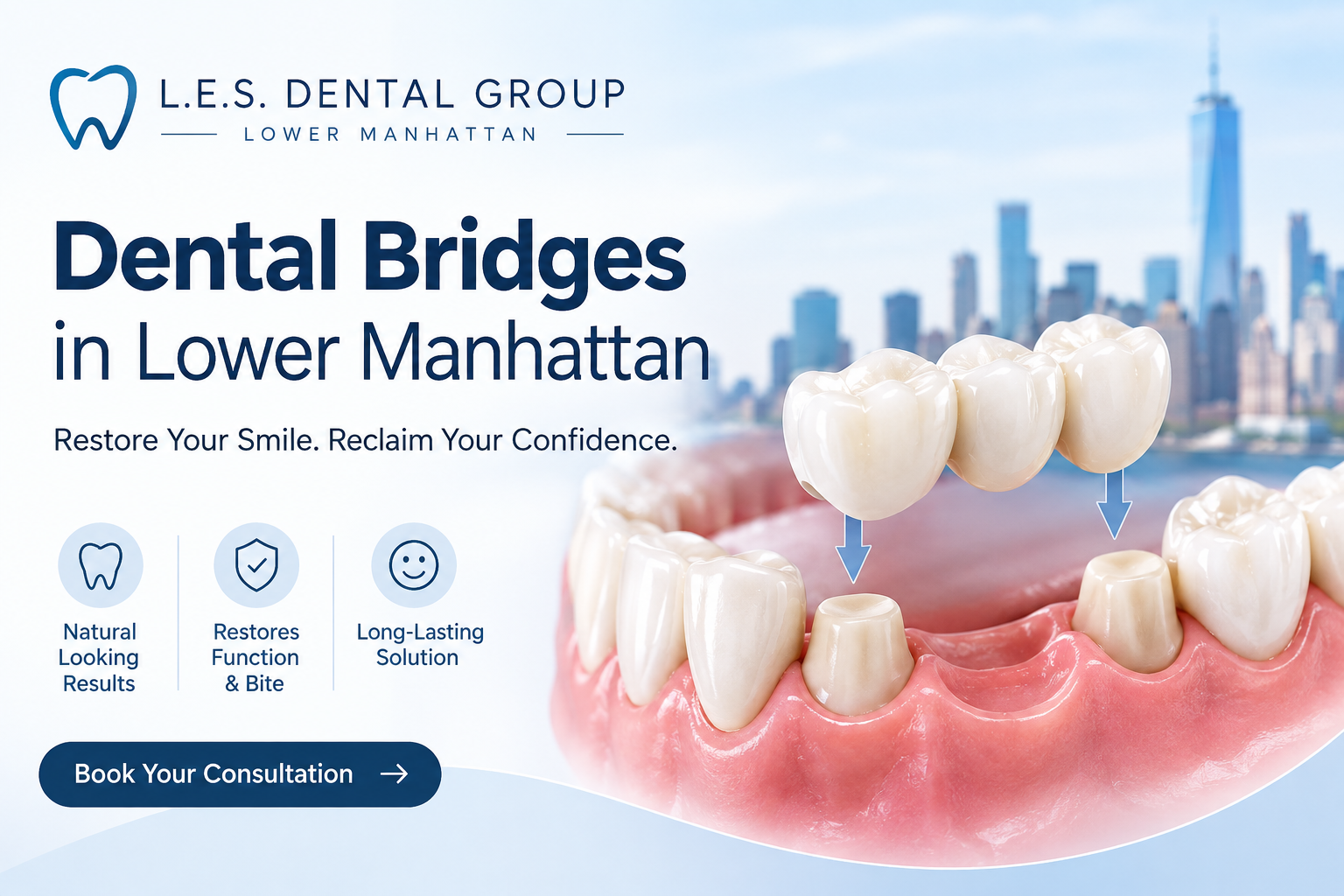
Missing teeth can affect more than the appearance of your smile. Gaps between your teeth may make chewing more difficult, affect the way you speak, and change how your remaining teeth come together. If you have one or more missing teeth, a dental bridge may be an effective tooth replacement option.
At L.E.S. Dental Group, patients looking for dental bridges in Lower Manhattan can receive personalised restorative dental care based on their oral health, existing teeth, and treatment goals. The practice provides restorative, cosmetic, family, preventive, and implant dentistry in New York City.
What Is a Dental Bridge?
A dental bridge is a fixed dental restoration designed to replace one or more missing teeth. It typically consists of an artificial tooth, known as a pontic, supported by neighbouring teeth or dental implants.
Unlike removable dentures, a traditional fixed bridge stays in place once it has been fitted. A dental bridge can help fill a visible gap while restoring important functions such as chewing and speaking.
Your dentist will assess the condition of your teeth, gums, bite, and jaw before determining whether a bridge is appropriate for you.
Who May Benefit From Dental Bridges?
Dental bridges may be considered for patients who have lost one or more teeth because of:
- Tooth decay
- Dental trauma or injury
- Gum disease
- Failed or severely damaged teeth
- Tooth extraction
- Other causes of tooth loss
Replacing a missing tooth can help restore the appearance and function of your smile. Your dentist will also consider the health and strength of the teeth surrounding the gap before recommending treatment.
Types of Dental Bridges in Lower Manhattan
There are several types of dental bridges available for replacing missing teeth. Each type is designed differently and may be suitable for different dental situations. The right choice depends on factors such as the number and location of missing teeth, the condition of the surrounding teeth, your gum health, your bite, and your overall oral health.
If you are considering dental bridges in Lower Manhattan, your dentist at L.E.S. Dental Group can evaluate your smile and discuss which type of bridge may be appropriate for your individual needs.
Traditional Dental Bridges in Lower Manhattan
A traditional dental bridge is one of the most common types of fixed bridges used to replace a missing tooth. It consists of an artificial tooth, called a pontic, positioned between two dental crowns. The crowns are placed over the natural teeth on either side of the gap to provide support for the replacement tooth.
Traditional bridges may be considered when the teeth surrounding the missing tooth are strong and healthy enough to support the restoration. Before treatment, your dentist will examine these teeth to make sure they can provide adequate support.
The supporting teeth may need to be reshaped to accommodate the crowns. Once the teeth have been prepared, impressions or digital scans can be used to help create a bridge that fits comfortably and matches the appearance of your natural teeth.
A traditional dental bridge can help:
- Replace a missing tooth
- Fill a visible gap in your smile
- Improve chewing function
- Support clearer speech
- Restore the overall appearance of your teeth
- Prevent neighbouring teeth from shifting into the empty space
Traditional bridges can be particularly useful when the adjacent teeth already require crowns or have extensive dental restorations. However, your dentist will need to assess the condition of these teeth before recommending this option.
Implant-Supported Dental Bridge
An implant-supported bridge is designed to replace multiple missing teeth using dental implants for support rather than relying entirely on neighbouring natural teeth.
Dental implants are small posts that are placed into the jawbone. Once the implants have integrated with the surrounding bone, they can provide a stable foundation for a bridge containing multiple replacement teeth.
For example, if several neighbouring teeth are missing, an implant-supported bridge may be used instead of placing an individual implant for every missing tooth. The exact design depends on the number of missing teeth, the available bone, and your individual treatment plan.
One potential advantage of an implant-supported bridge is that the restoration does not require the same type of support from neighbouring natural teeth as a traditional bridge. This can be an important consideration when the adjacent teeth are healthy and you want to preserve them.
However, not every patient is immediately suitable for implant-supported treatment. Your dentist may need to evaluate your jawbone, gums, bite, and overall oral health before determining whether dental implants are appropriate.
At L.E.S. Dental Group, patients considering dental bridges in Lower Manhattan can discuss both traditional and implant-supported tooth replacement options with their dental team. The practice also provides implant dentistry, allowing treatment options to be considered based on each patient's individual circumstances.
Cantilever Dental Bridge
A cantilever dental bridge is another type of fixed bridge, but unlike a traditional bridge, it is supported by a tooth on only one side of the missing tooth.
In a traditional bridge, the replacement tooth is usually supported by teeth on both sides of the gap. With a cantilever bridge, the artificial tooth is attached to a crown that is supported by a single neighbouring tooth.
Because the restoration receives support from only one side, cantilever bridges are not suitable for every location in the mouth. The amount of biting pressure in the area is an important consideration.
For example, your dentist may be more cautious about using a cantilever bridge in areas that experience significant chewing forces. The strength and condition of the supporting tooth must also be carefully evaluated.
Before recommending this type of bridge, your dentist will consider:
- The location of the missing tooth
- The condition of the supporting tooth
- Your bite and chewing forces
- The health of your gums
- The amount of available space
- Your overall dental health
A cantilever bridge can provide a fixed replacement for a missing tooth in selected situations. However, because it relies on a single supporting tooth, careful treatment planning is important.
Maryland Dental Bridge
A Maryland dental bridge is a more conservative type of dental bridge that uses a framework or wings attached to the back surfaces of neighbouring teeth. Unlike a traditional bridge, it generally does not require the supporting teeth to be prepared for full crowns.
The replacement tooth is attached to the framework, which is bonded to the neighbouring teeth. Because of its design, a Maryland bridge may be considered for certain areas of the mouth, particularly when replacing a missing front tooth.
One of the potential advantages of a Maryland bridge is that it can require less alteration of the neighbouring natural teeth compared with a traditional bridge. However, the suitability of this option depends on factors such as the position of the missing tooth, the condition of the supporting teeth, your bite, and the forces placed on the restoration.
Maryland bridges may not be appropriate for every patient or every location in the mouth. Your dentist will assess your individual circumstances before recommending this treatment.
Which Type of Dental Bridge Is Right for You?
Choosing the right dental bridge requires more than simply determining where the missing tooth is located. Your dentist will consider several factors before recommending a treatment option.
These may include:
- The number of missing teeth
- The location of the missing teeth
- The health of neighbouring teeth
- The condition of your gums
- Your bite and chewing pattern
- The amount of available jawbone
- Your overall oral health
- Your aesthetic goals
- Your long-term tooth replacement needs
For example, a patient with one missing tooth and two strong neighbouring teeth may be considered for a traditional bridge, while someone missing several adjacent teeth may have an implant-supported bridge discussed as an option.
In other situations, a Maryland or cantilever bridge may be considered depending on the location of the missing tooth and the amount of pressure placed on the restoration.
There is no single dental bridge solution that is appropriate for every patient. A professional dental examination is important for determining which option is most suitable for your smile.
Discuss Dental Bridges in Lower Manhattan With L.E.S. Dental Group
If you have one or more missing teeth, a dental bridge may help restore the appearance and function of your smile. Understanding the different types of bridges can help you have a more informed conversation with your dentist about your treatment options.
At L.E.S. Dental Group, patients looking for dental bridges in Lower Manhattan can receive an individual evaluation and discuss available tooth replacement solutions. Your dentist can examine the missing-tooth area, assess the surrounding teeth and gums, and explain which type of dental bridge may be appropriate for your needs.
If you are considering replacing a missing tooth, schedule a consultation with L.E.S. Dental Group to discuss your options for restoring your smile.
What Is the Dental Bridge Process?
The process for getting a dental bridge depends on the type of restoration you need. Generally, treatment involves several important steps.
1. Dental Examination
Your dentist will examine your teeth and gums and assess the area where the tooth is missing. X-rays or other diagnostic imaging may be recommended when necessary.
2. Treatment Planning
Your dentist will discuss your treatment options and explain how a bridge would fit into your overall dental care plan. Factors such as the health of your neighbouring teeth, bite, aesthetics, and long-term maintenance will be considered.
3. Preparing the Supporting Teeth
For some traditional bridges, the supporting teeth need to be carefully prepared so they can support the crowns that hold the bridge in place.
4. Creating Your Dental Bridge
Your dentist will take the necessary measurements or impressions to ensure the restoration is designed to fit your mouth properly. The colour and shape can also be considered to help the replacement tooth blend naturally with your smile.
5. Fitting the Bridge
Once the bridge is ready, your dentist will check its fit, appearance, and bite before securing it in position.
Benefits of Dental Bridges in Lower Manhattan
A dental bridge can provide several benefits for patients with missing teeth.
Restores Your Smile
A missing tooth can create a noticeable gap. A well-designed bridge can fill that space and create a more complete-looking smile.
Improves Chewing
Missing teeth can make it harder to chew certain foods comfortably. Replacing the missing tooth can help restore dental function.
Supports Speech
Teeth play an important role in forming certain sounds. Filling a significant gap may help improve speech affected by tooth loss.
Helps Maintain Tooth Alignment
When a tooth is missing, neighbouring teeth can potentially move into the empty space. Replacing the missing tooth can help maintain the existing arrangement of your teeth.
Fixed Tooth Replacement
Unlike removable dentures, a fixed dental bridge is designed to remain in place. This can provide a stable option for replacing certain missing teeth.
Dental Bridges vs. Dental Implants
Dental bridges and dental implants are both options for replacing missing teeth, but they work differently.
A traditional dental bridge generally relies on neighbouring teeth for support. A dental implant, on the other hand, uses an implant placed into the jawbone to support a replacement tooth.
The appropriate treatment depends on several factors, including your oral health, bone structure, the number of missing teeth, the condition of neighbouring teeth, and your personal preferences.
L.E.S. Dental Group offers both restorative and implant dentistry, so your dentist can discuss the available options during your consultation.
How to Care for Your Dental Bridge
Good oral hygiene is important for maintaining both your bridge and the teeth supporting it.
You should:
- Brush your teeth twice a day with fluoride toothpaste.
- Clean around the bridge carefully.
- Floss or use an appropriate interdental cleaning method.
- Attend regular dental examinations and professional cleanings.
- Avoid using your teeth to open packages or bite hard objects.
- Follow your dentist's specific care instructions.
Cleaning underneath and around the bridge is particularly important because food particles and plaque can accumulate around the restoration and supporting teeth.
How Long Do Dental Bridges Last?
The lifespan of a dental bridge can vary depending on factors such as the type of bridge, oral hygiene, bite forces, diet, and the health of the supporting teeth and gums.
Regular dental visits allow your dentist to monitor the bridge and surrounding teeth and identify potential problems early.
Why Choose L.E.S. Dental Group for Dental Bridges in Lower Manhattan?
L.E.S. Dental Group provides a range of dental services, including restorative and implant dentistry, with treatment plans tailored to individual patient needs. The practice has served the Lower East Side community for nearly four decades and focuses on personalised, patient-centred care.
If you are living with a missing tooth or an uncomfortable gap, a dental bridge may be one of the options worth discussing with a dentist.
Schedule a Dental Bridge Consultation in Lower Manhattan
Replacing a missing tooth starts with understanding your available treatment options. At L.E.S. Dental Group, your dentist can evaluate your smile, discuss your concerns, and develop a treatment plan based on your individual dental needs.
If you are searching for dental bridges in Lower Manhattan, contact L.E.S. Dental Group to request an appointment and learn whether a dental bridge is right for you. The practice accepts appointment requests online and can also be contacted directly.
Quick Links
Helpful Articles
article_category: East Village
article_category: products
article_category: psychiatry
article_category: faqs
article_category: cats
article_category: general
article_category: services
article_category: technology
article_category: dogs
article_category: restorative
article_category: vision therapy
article_category: contact lenses
article_category: health
article_category: conditions
article_category: eye surgery co-management
article_category: exotic
article_category: cosmetic
article_category: surgical procedures
article_category: aesthetics
article_category: preventative
article_category: ocular disease management
article_category: eyeglasses
article_category: eye health
article_category: large animal
[]
article_category: products
article_category: psychiatry
article_category: faqs
article_category: cats
article_category: general
article_category: services
article_category: technology
article_category: dogs
article_category: restorative
article_category: vision therapy
article_category: contact lenses
article_category: health
article_category: conditions
article_category: eye surgery co-management
article_category: exotic
article_category: cosmetic
article_category: surgical procedures
article_category: aesthetics
article_category: preventative
article_category: ocular disease management
article_category: eyeglasses
article_category: eye health
article_category: large animal
[]
Flowbite is an open-source library of interactive components built on top of Tailwind CSS including buttons, dropdowns, modals, navbars, and more.
Check out this guide to learn how to get started and start developing websites even faster with components on top of Tailwind CSS.

Keep In Touch
For non-urgent questions or to learn more about our services, contact us today!
© 2026 L.E.S. Dental Group. All rights Reserved - Accessibility Statement - Privacy Policy - Sitemap
Managed and Designed by 